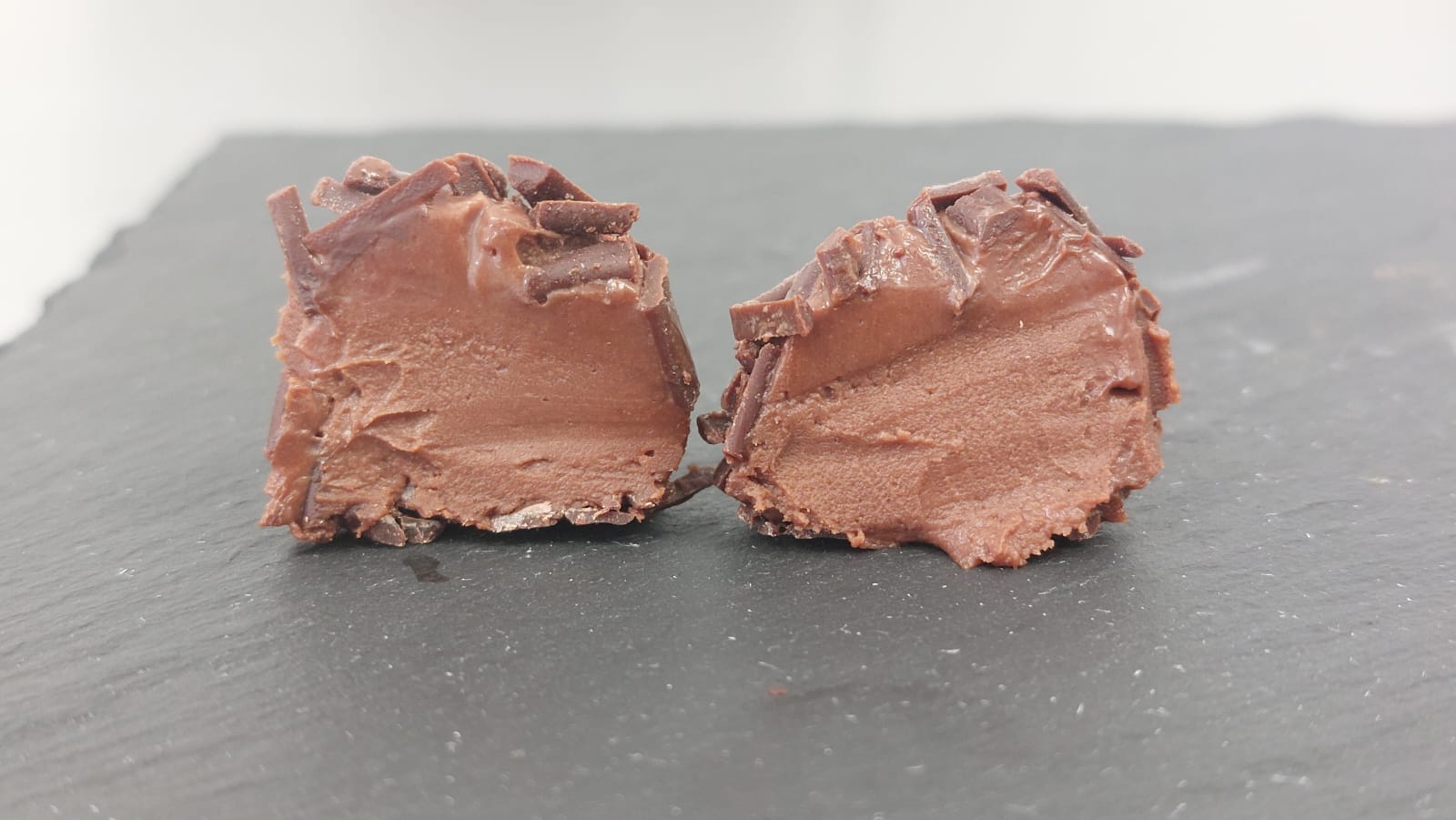
Ganache and praliné are two of the most common bonbon fillings. If you're interested in the science of chocolate, keep reading! We'll dive into what defines each of these fillings, and how they're different.

What is ganache?
Ganache is an emulsion; in other words, a mix of liquids and fats. In this case the primary fat component is chocolate, which contains cocoa butter. The liquid component in a ganache is traditionally cream, although it can also be plant-based milks, water, alcohol or fruit purée, like in our passionfruit bonbon.
If you've ever tried to mix vinegar and olive oil to make a vinaigrette, you'll know that water and oil don't mix. If we want these two components to stick together, we have to make an emulsion: blend them really ferociously with the hand blender, and possibly add some kind of protein to help them bind. That's why people often add egg (an emulsifier) to mayonnaise.
Still, no matter how hard you blend, all emulsions are inherently unstable. Water and oil don't like to be together. And that's exactly the quality we're looking for in a chocolate bonbon. As soon as you bite into it, it starts to melt in your mouth, which allows the flavour notes to shine.
What makes an artisanal chocolate bonbon different from a long-life industrial bonbon?
The issue with ganache is that it contains liquid, and liquid is the cradle of life - in this case, microorganisms like mould or bacteria. As artisanal chocolatiers, we create recipes that respect a set balance of fats, liquids, sugars and solids in order to guarantee a shelf life of one to two months under proper storage conditions. However, it's impossible to guarantee a longer shelf life without adding preservatives to a ganache. That's why most bonbons sold in the supermarket contain alternative fats, such as palm oil, instead of liquids. This allows them to obtain a "silky" texture that still marks a clear difference from the chocolate coating, although it will never be quite as creamy as a fresh ganache.

What's praliné? And how about gianduja?
Praliné is a sweet paste made by grinding nuts together with sugar. Gianduja is what you get when you combine nut paste with chocolate. Strictly speaking, gianduja is made with hazelnuts and chocolate, although today the term is used loosely to refer to pastes made with other nuts, such as a ''pistachio duja.''
Mixing the cocoa butter with the oil present in the nuts - which is liquid at room temperature - creates a paste that is slightly softer than chocolate on its own. It can be made even softer by adding vegetable oils, which is how we would get Nutella.
Since neither praliné nor gianduja contain liquid, they don't offer the extremely creamy texture of a ganache. But these fillings have other advantages. Since they don't contain liquid, we can add crispy components and they won't lose their crunch over time, as in the case of our hazelnut bonbon with crispy wafer. Gianduja and praliné also have a much longer shelf life, since they don't contain any water where microorganisms can grow.