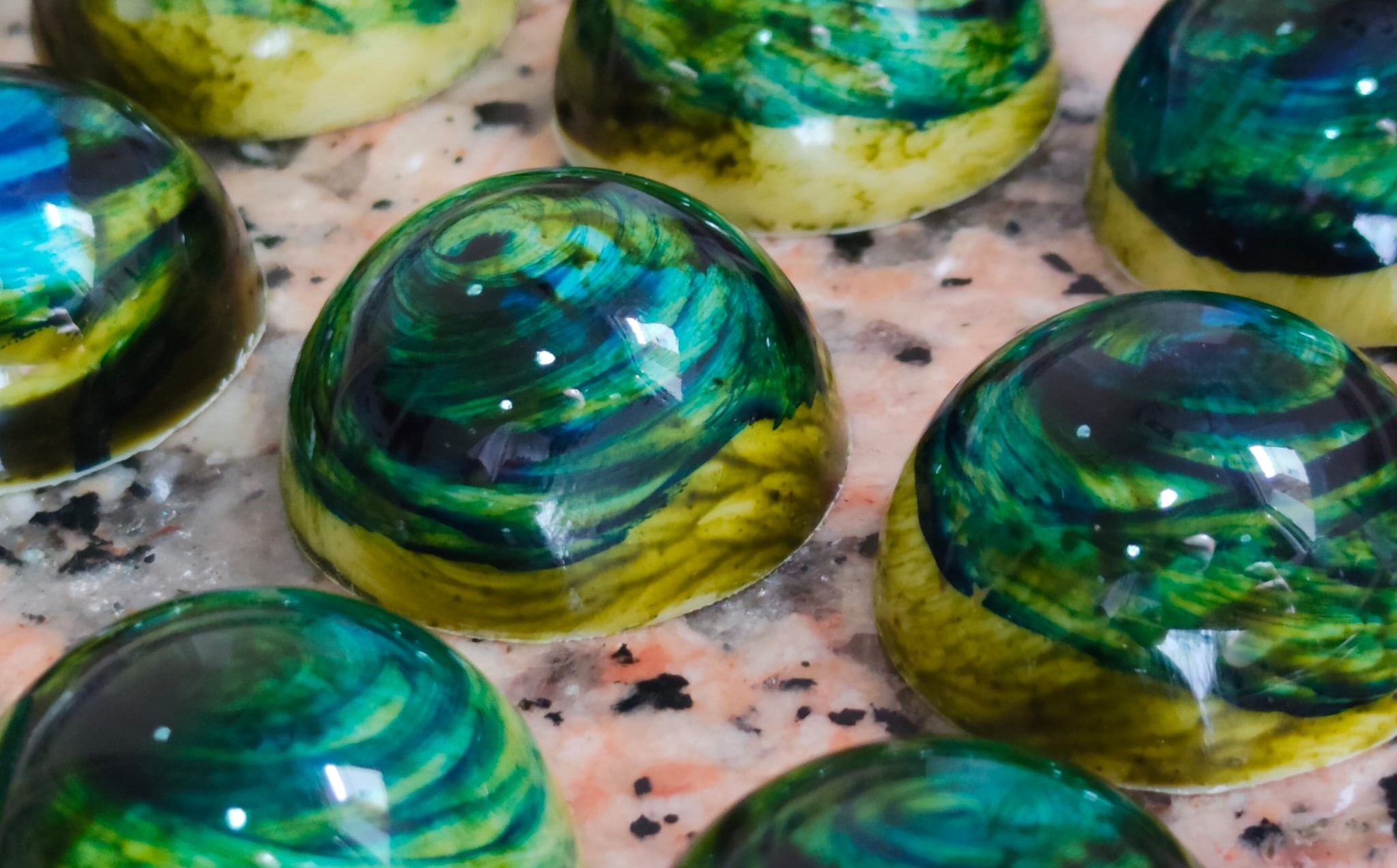
There are many ways to decorate chocolates. Today we'll take a look at the methods we tend to use at Danielle Pacheco Chocolatier.
Steps for decorating a chocolate bonbon
We make moulded chocolates, which means we need to decorate the mould before adding chocolate to make the shell. We start by choosing the colours and mixing them if necessary. Then, we temper the cocoa butter and apply the colour to the mould using a foodsafe paintbrush, a sponge or a glove.

What makes the chocolates shine?
Chocolate shines thanks to the cocoa butter, one of the core ingredients extracted from the cocoa bean. Cocoa butter is a very unique ingredient because it is polycrystalline. This means that when it changes from liquid to solid form, it can take on different appearances depending on how the crystals arrange themselves. It's similar to how carbon can take on the brilliant shape of a diamond or the rougher form of carbon.
In order to make chocolate shiny we need to know how to handle it according to established temperature curves, timing and agitation. This process is called tempering, or precrystallizing, the chocolate. When chocolate has been well tempered, the crystals fit together snugly and the final product has a notable shine and snap. However, this shine is lost when the temperature of the chocolate rises above 22 degrees.
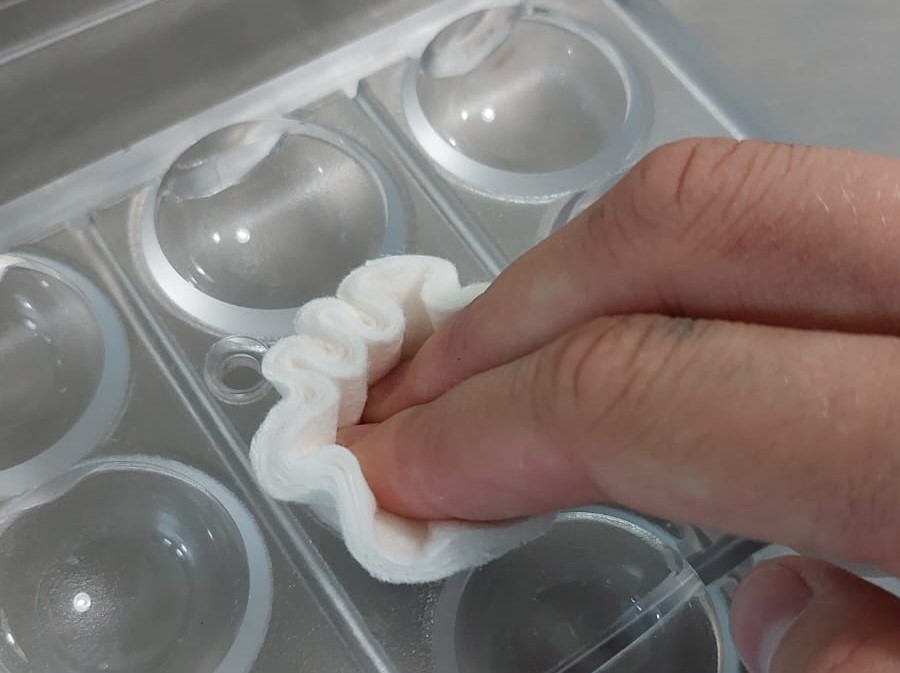
We use plastic moulds rather than silicone moulds, because chocolate takes on the texture of the surface on which it hardens. We polish each cavity before decorating so the chocolate will shine as much as possible.
What type of colouring do we use in our chocolates?
There are many types of pigments that can be used to colour chocolate bonbons. At Danielle Pacheco Chocolatier we use exclusively natural pigments. We boycott artificial colours, as these are made with petrochemicals and we can't stomach the thought of having petrochemicals in our chocolate!
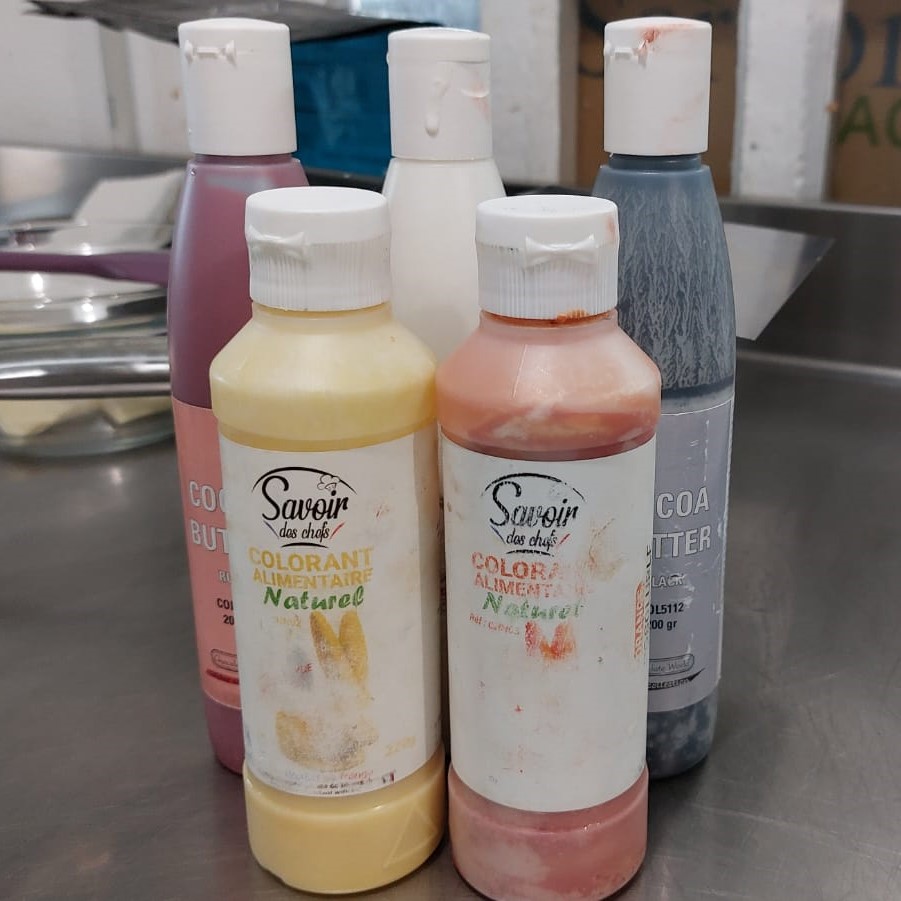
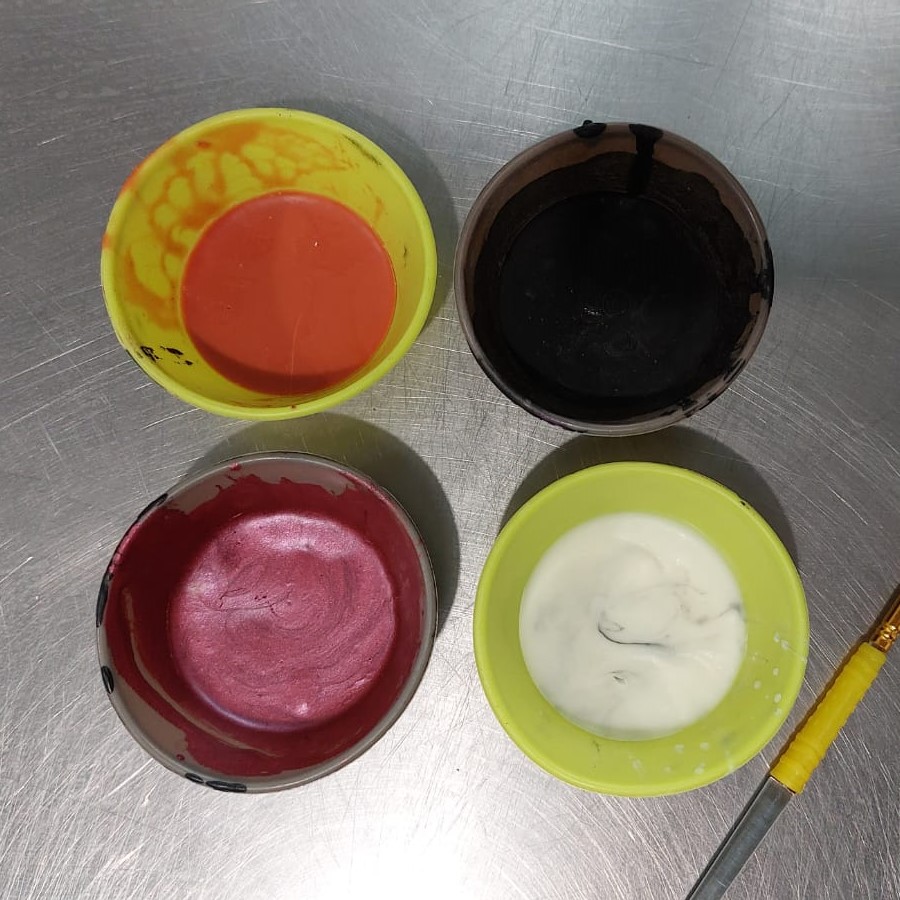
We get some of our colours directly from food. For example, for green food colouring we use matcha powder, and our dark blue comes from spirulina. These powders can be mixed directly into melted cocoa butter and used directly. We buy our orange cocoa butter already made, but it's made from turmeric and radish.
Otros colorantes son de origen natural, pero no vienen de plantas. Destacan el negro (carbón vegetal, E153), el blanco (e170, carbonato de calcio) y el rojo (óxido férrico, E172).
The only synthetic colouring we have used in the past is blue E133. It's almost impossible to find a natural blue food colouring, since this is a colour that doesn't exist much in nature. However, we were very excited to find a provider that makes all-natural blue colouring with spirulina, so that's what we use now!
What's titanium dioxide, and why isn't it used?
Until 2022, titanium dioxide (E171) was widely used to add a white backing to bonbons and other food products. Titanium dioxide is very opaque. When painting colours onto a dark chocolate bonbon, it helped to add a layer of white behind the colour to make the colour pop more. It's a similar concept to painting on a white canvas instead of a black canvas.
In 2022, the European Commission banned the use of titanium dioxide because research indicated it might be linked to chronic health conditions. Chocolatiers in Europe now use calcium carbonate (E170) instead, but this type of white food colouring is not as opaque, hence why bonbons aren't quite as colourful as they were a few years ago.
Qué son los colorantes AZOICOS?
Los AZO dyes are dyes that contain a specific chemical structure, based on nitrogen ("azote" is French for nitrogen, a word based on the Greek a- (without) and zoion (life), because living beings can't survive in pure nitrogen). These dyes are organic, meaning they're carbon-based; but synthetic, meaning they're made from petrochemicals. More than half of the dyes you find in clothing, food, and other commercial uses are AZO dyes.
Los Southampton colours refers to six azo dyes that may cause attention problems in children when consumed in very high doses. Southampton colors are Tartrazine (E102), Quinoline Yellow (E104), Sunset Yellow FCF (E110), Azorubine/Carmoisine (E122), Ponceau 4R (E124) and Allura Red AC (E129).
At Danielle Pacheco Chocolatier we do not use any AZO dyes or Southampton colours. While they continue to be legal in Europe, we feel it's unnecessary to include additives with potentially harmful effects on children. All our chocolate bonbons are decorated with natural plant- or mineral-based colours.
For products that do use Southampton colours, companies are legally obliged to include a notice of the potentially harmful effects on activity and attention in children.